There are five main types of industrial automation services fixed (hard), programmable, flexible (soft), integrated, and robotic process automation (RPA) plus the related distinction between process and discrete automation. Each type fits a different combination of production volume, product variety, and changeover frequency, so the “best” automation strategy depends on the specific manufacturing goal rather than on which technology is newest.
Walk through two manufacturing facilities. In the first, products move down a production line at high speed, and every machine repeats the same task without variation. In the second, the same equipment might produce one item in the morning, switch to a different product after lunch, and handle a custom variation by the end of the day. Both facilities are automated, but they rely on very different automation strategies and that distinction affects cost, flexibility, and long-term ROI more than most manufacturers realize.
Automation is often discussed as though it were a single technology. In reality, there are several distinct types, each designed for a specific combination of production volume, product variety, and operational requirement. A solution built for a beverage bottling plant is usually the wrong fit for an electronics manufacturer producing multiple product variants. Understanding the differences helps manufacturers avoid expensive mismatches and make better investment decisions.
A growing share of manufacturers are moving toward higher automation levels: a recent global manufacturing outlook projects that the median share of industrial manufacturers expecting highly automated processes will rise from 18% to 50% by 2030 (PwC Global Industrial Manufacturing Sector Outlook, 2026). This shift is reshaping how production planning gets done across the industry, with many companies adopting Turnkey Automation Services to streamline operations, improve efficiency, and integrate advanced automation solutions from planning through implementation.
Automation, broadly, is the use of machines, software, or control systems to perform tasks with limited human intervention. How a given system is designed how rigid or reprogrammable it is determines which category it belongs to.
What Is Fixed (Hard) Automation?
Fixed automation performs one fixed sequence of operations repeatedly, at high speed, and changing the product requires significant mechanical rework or new equipment.
A large automotive assembly line is the clearest example: thousands of identical components move through the same stations every day, because consistency and volume matter more than variety.
Common examples: automotive assembly lines, beverage bottling systems, high-volume packaging lines, and conveyor-based production systems.
Fixed automation works best with very high production volumes, stable product designs, long production runs, and minimal variation between products.
It’s a mistake to treat fixed automation as outdated. For products made in extremely large quantities, industry practice still treats it as the lowest-cost, highest-throughput option when the same product is manufactured repeatedly over a long run.
What Is Programmable Automation?
Programmable automation uses software or control systems to change production instructions between batches, so equipment can switch products without major mechanical changes.
In a factory producing multiple sizes of an industrial component, operators load a new program and reconfigure equipment once one batch finishes and before the next begins. The changeover takes time, but it offers far more flexibility than a fixed line. With the right Turnkey Automation approach, manufacturers can integrate adaptable systems that simplify reconfiguration, improve production efficiency, and support changing product demands without sacrificing long-term performance.
Common examples: CNC machining centers, industrial robots, PLC-controlled manufacturing equipment, and batch production systems.
Programmable automation best fits medium-volume production, batch manufacturing, multiple product variations, and operations that need periodic changeovers.
What Is Flexible (Soft) Automation?
Flexible automation switches between products automatically, with minimal or no interruption, instead of requiring a lengthy reprogramming step between runs.
This has become more important as customer expectations shift toward customization and shorter product life cycles.
Common examples: flexible manufacturing systems (FMS), multi-product robotic cells, automated machining centers with dynamic tooling, and smart production lines.
In a manufacturer producing several versions of the same product, the system detects which item is coming next and adjusts automatically instead of stopping for a manual setup change.
Benefits: faster product changeovers, greater customization capability, reduced downtime, and improved responsiveness to demand. The tradeoff is higher implementation complexity and a larger upfront investment.
What Is Integrated Automation?
Integrated automation connects multiple automation technologies equipment, software, sensors, and controllers into one coordinated system instead of isolated machines performing separate tasks.
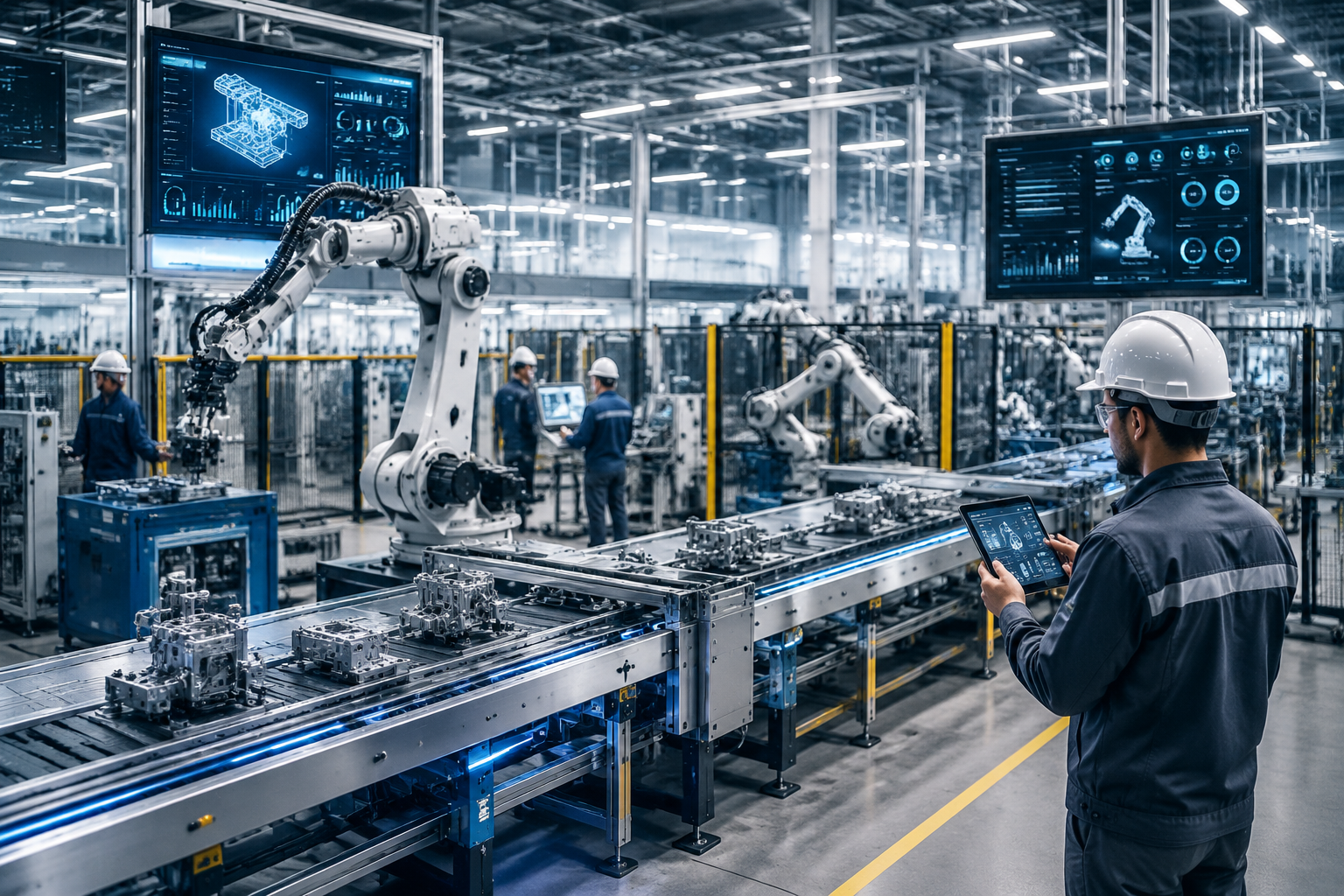
Production data flows continuously between systems, giving managers visibility across the entire manufacturing process rather than one workstation at a time. Integrated automation typically combines fixed, programmable, and flexible systems within a single connected setup, and it’s the long-term goal for most manufacturers pursuing digital transformation.
Common examples: fully connected manufacturing plants, automated warehouses linked to production systems, enterprise-wide manufacturing control systems, and smart factory environments.
Because integrated automation spans equipment, software, and workflow design at once, manufacturers with requirements beyond off-the-shelf systems often bring in an integration partner such as RBR Automation to design a tailored setup rather than assembling one internally.
Process Automation vs. Discrete Automation: What’s the Difference?
Process automation controls a continuous material or reaction; discrete automation produces individual, countable units.
| Type | Typical Output | Common Industries | Example |
| Process Automation | Continuous materials | Chemicals, food processing, oil & gas | Mixing ingredients continuously |
| Discrete Automation | Individual products | Automotive, electronics, packaging | Building individual products on an assembly line |
Process automation focuses on controlling variables such as temperature, pressure, flow rate, and chemical composition. Discrete automation focuses on producing distinct items one unit at a time. Narrowing down which category applies to a given operation is usually the fastest way to shortlist realistic automation options.
What Is Robotic Process Automation (RPA)?
RPA uses software bots to handle repetitive digital tasks in office environments, without involving physical manufacturing equipment.
Common examples: data entry, invoice processing, report generation, customer information updates, and order processing workflows.
Where an employee might copy the same information between two systems every day, an RPA bot performs that task automatically, which reduces errors and frees the employee for higher-value work. RPA doesn’t replace industrial automation it’s a separate category built for administrative and business processes rather than the factory floor.
Five Types of Automation Compared
| Type | Volume | Flexibility | Setup Cost | Changeover | Best Fit |
| Fixed (Hard) | Very high | Very low | Low per unit at scale | Rare / costly | Automotive, bottling, high-volume packaging |
| Programmable | Medium | Moderate | Moderate | Scheduled, between batches | CNC shops, batch manufacturing |
| Flexible (Soft) | Medium–high | High | High | Automatic, minimal downtime | Multi-variant electronics, customization |
| Integrated | Any | Facility-wide | Highest (systems-wide) | Coordinated across systems | Smart factories, digital transformation |
| RPA (office) | N/A — digital tasks | High (software-level) | Low–moderate | Fast (bot reconfiguration) | Data entry, invoicing, reporting |
How Do You Choose the Right Automation Type?
Many organizations start with the wrong question “What automation technology should we buy?” A more useful starting question is: what production challenge are we actually trying to solve?
Four-Step Evaluation Method
- Assess production volume.
- Measure product variation.
- Evaluate changeover frequency.
- Calculate long-term ROI requirements.
As a general guide: high volume with low variation points to fixed automation; batch production points to programmable automation; frequent product changes point to flexible automation; and facility-wide optimization points to integrated automation.
Automation Types in Practice: Real-World Examples
Fixed automation example: A beverage manufacturer produces millions of identical bottles a year, where production speed matters more than flexibility, so a dedicated bottling and packaging line makes sense.
Programmable automation example: A machine shop manufactures components for several customers and reprograms its equipment between production runs to accommodate each design.
Flexible automation example: An electronics manufacturer produces multiple product variations at once, and its automated systems switch between configurations with minimal downtime.
Integrated automation example: A factory links production equipment, inventory management, quality control, and reporting into a single connected environment, so information moves automatically throughout the operation.
A common growth path looks like this: manual processes are enough at first; as order volume rises, bottlenecks appear; the company introduces programmable automation for repetitive tasks; demand keeps growing and more systems get connected; eventually, production equipment, material handling, quality monitoring, and business software all operate as one integrated environment. That gradual progression is usually more realistic than attempting a full transformation in one step.
Conclusion
Choosing an automation type isn’t about memorizing definitions it’s about matching the right technology to the operational need. Fixed automation delivers speed. Programmable automation adds adaptability. Flexible automation supports customization. Integrated automation connects the entire operation. RPA extends automation beyond the factory floor into administrative workflows. For manufacturers evaluating an investment, the goal isn’t the most advanced technology available it’s the technology that fits the specific challenge at hand.
Manufacturers whose requirements go beyond standard, off-the-shelf systems often work with an experienced integration partner, such as RBR Automation, to design a tailored, turnkey approach.
Frequently Asked Questions
What makes a good automation strategy?
A good automation strategy aligns automation investments with production goals, operational constraints, and expected business outcomes, rather than focusing on the technology alone.
How do you choose an automation type for a manufacturing process?
Choose an automation type by evaluating production volume, product variety, changeover frequency, and future growth plans before selecting a specific solution.
What are the best practices for automation planning?
Best practices for automation planning include mapping current workflows, identifying bottlenecks, defining measurable objectives, and considering integration requirements from the start of the project.
Does RBR Automation provide custom automation solutions?
Yes RBR Automation designs and implements custom turnkey automation systems tailored to specific manufacturing environments.
When should a company hire an automation integration partner?
When should a company hire an automation integration partner?