What Is Industrial Automation?
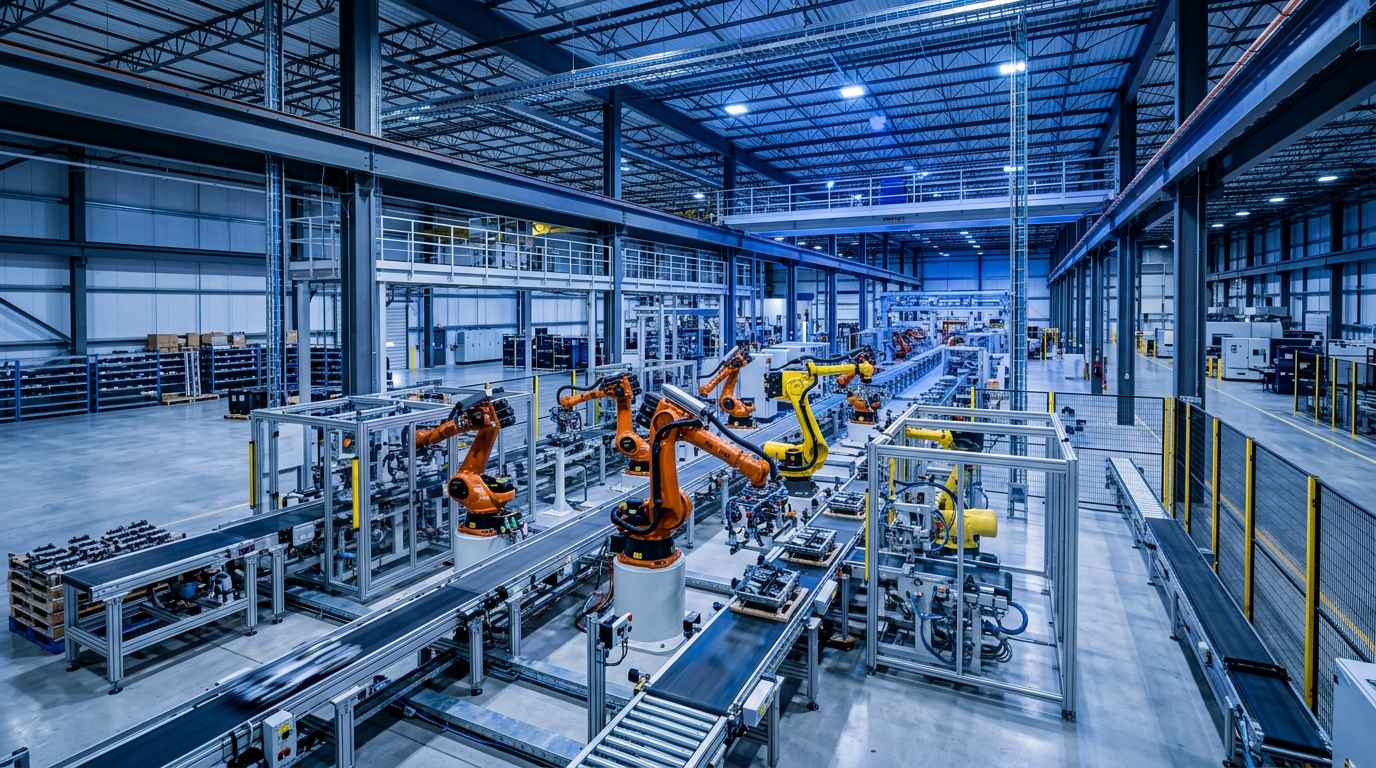
Industrial automation is the use of machines, sensors, and software to perform manufacturing tasks automatically reducing manual labor, improving consistency, and increasing production speed.
Instead of workers controlling every step by hand, Industrial Automation Services help automated systems manage routine and repetitive processes. This includes filling and packaging products, moving materials between stations, monitoring equipment temperatures, controlling machine speeds, and inspecting product quality in real time.
People still matter in automated facilities. Workers operate systems, solve problems, and oversee production. Automation simply handles the repetitive tasks that slow output and introduce errors.
At RBR Automation, we have seen this firsthand across more than a decade of building custom automation systems for U.S. manufacturers in automotive, food processing, electronics, and heavy industrial facilities. The core goal is always the same: help factories run more consistently, safely, and efficiently.
- Industrial automation reduces manual work and improves production consistency
- Sensors, controllers, and software work together to keep production running smoothly
- Automation improves speed, quality, and workplace safety
- Most manufacturers start with one process and scale from there
- RBR Automation builds custom, turnkey automation systems designed around your specific facility and production goals
How Industrial Automation Works
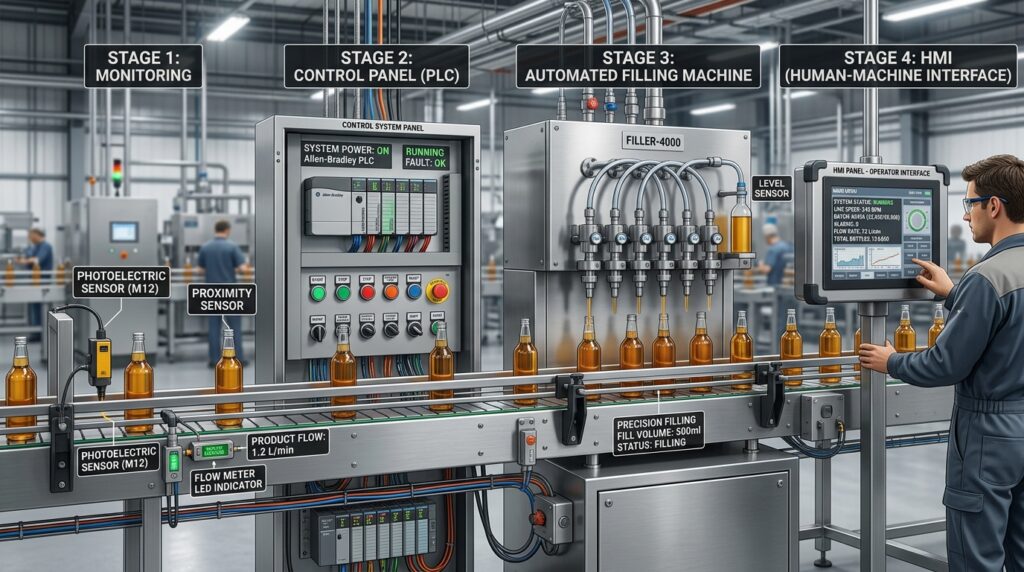
Most automated systems follow a continuous four-step process:
- Sensors collect information: detecting position, temperature, pressure, motion, or speed
- Controllers process the information: deciding what action should follow
- Machines respond automatically: adjusting, moving, filling, or stopping as needed
- Operators monitor the system: reviewing alerts, performance data, and production status
Here is a simple real-world example. In a bottling facility, a sensor detects an empty bottle entering a station. The controller signals the filling machine with the correct volume. The bottle fills and advances automatically to the next station. This cycle repeats hundreds or thousands of times per shift consistently, without manual intervention.
That is automation in action.
The Main Components of an Automated System
Understanding how automation works becomes much easier when you break it into its core components.
Sensors
Sensors act as the system’s eyes and ears. They detect heat, motion, pressure, speed, and product position feeding real-time data to the control system.
Controllers (PLCs and SCADA Systems)
Controllers are the brain. Programmable Logic Controllers (PLCs) receive sensor data and execute preprogrammed decisions. SCADA (Supervisory Control and Data Acquisition) systems provide higher-level monitoring and data logging across the entire facility.
Motors and Actuators
These components create physical movement powering conveyor belts, robotic arms, dispensing systems, pumps, and transfer equipment.
Human-Machine Interfaces (HMIs)
HMI screens allow operators to monitor system status, view alerts, adjust parameters, and track production performance in real time.
Software and Control Systems
Production software tracks output, monitors equipment health, and enables predictive maintenance helping facilities identify problems before they cause downtime.
At RBR Automation, we integrate all of these components into fully assembled, turnkey systems. Every project is designed around your actual floor layout, equipment, and production targets not a generic off-the-shelf configuration.
Types of Industrial Automation
Different production environments require different automation approaches.
| Automation Type | Best Fit | Strength | Limitation |
| Fixed Automation | High-volume, repetitive production | Fast and highly efficient | Difficult to modify |
| Programmable Automation | Batch production with product variations | Flexible for changeovers | Requires reprogramming between runs |
| Flexible Automation | Mixed-product manufacturing | Quick changeovers without reprogramming | Higher upfront investment |
| Integrated Automation | Smart, connected factories | Full system visibility and data integration | More complex to implement |
Not every facility needs the most advanced option. Many manufacturers start with a targeted upgrade: a conveyor system, a precision dispensing unit, or a single automated inspection station and see significant returns before scaling further.
Benefits of Industrial Automation
Better Product Quality
Automated systems repeat tasks the same way every cycle. This eliminates the variation that comes from manual handling and reduces defects, rework, and waste across production runs.
Reduced Downtime
When systems are equipped with real-time monitoring and predictive maintenance capability, problems are identified before they cause failures. According to Deloitte’s 2023 manufacturing outlook, predictive maintenance programs can reduce unplanned downtime by 30% to 50% in industrial environments.
Improved Workplace Safety
Automation removes workers from direct exposure to hazardous, repetitive, or physically demanding tasks reducing injury risk and improving overall facility safety.
Faster Production Output
Automated systems can run longer cycles with consistent output, without the natural variation and fatigue that affect manual operations.
Real-Time Production Visibility
With HMIs and integrated software, production managers can track output, identify bottlenecks, and make data-informed decisions during live operations, not after the shift ends.
In our experience at RBR Automation, manufacturers who invest in automation for one critical bottleneck typically achieve full ROI within 12 months and almost always expand the system after seeing initial results.
Common Industri al Automation Examples
Automated systems are already running in many manufacturing environments you interact with daily.
Packaging and Labeling Systems: Machines automatically sort, label, fill, and seal products at consistent speeds with minimal manual handling.
Robotic Welding: Automotive and fabrication facilities use robotic welding arms for precision joints that manual welding cannot consistently replicate at volume.
Conveyor and Material Transfer Systems: Automated Material Handling systems move products and materials between production stations without manual lifting or transport delays.
Automated Visual Inspection: Camera-based systems check products for dimensional accuracy, surface defects, and labeling errors during production catching issues that manual inspection misses at speed.
Precision Dispensing Systems: Adhesives, sealants, lubricants, and process fluids are applied through Dispensing Systems with exact, repeatable accuracy every cycle, reducing waste and ensuring consistent product quality.
Production Line Automation: Full production lines can be designed and integrated through Production Line Automation to handle multiple process stages, from material input to finished product output, with consistent throughput across every shift.
Industrial Automation vs. Manual Operations
The conversation around automation vs. manual production is not about choosing one exclusively. Most manufacturing facilities use both, and knowing when to automate and when not to is what matters.
Manual operations still make sense for:
- Small or custom production runs
- Highly variable products requiring skilled craftsmanship
- Processes requiring human judgment or tactile feedback
Automation becomes the better choice when:
- Tasks repeat constantly at volume
- Consistency is critical to product quality or regulatory compliance
- Downtime from errors or fatigue is costing real money
- Production demand is increasing faster than headcount can scale
One thing many manufacturers underestimate: automation does not always mean large robots or full line replacement. Adding sensors to an existing machine, automating one transfer point, or integrating a precision dispensing unit can deliver measurable results without rebuilding your entire facility.
How to Start Industrial Automation in a Factory
For U.S. manufacturers evaluating where to begin, a practical, phased approach reduces risk and delivers faster ROI.
Step 1: Identify Repetitive Problem Areas
Look for tasks causing production delays, quality inconsistencies, or high manual labor costs. These are your highest-value automation targets.
Step 2: Measure the Current Impact
Quantify downtime, defect rates, throughput gaps, or labor hours being consumed by these processes. This data drives the business case.
Step 3: Assess Existing Equipment Compatibility
Many facilities can automate by upgrading or integrating with existing equipment not by replacing everything. Understanding your current setup first prevents unnecessary capital spend.
Step 4: Start with One Process
Automating one high-impact process first reduces risk, builds internal confidence, and provides performance data that informs future phases.
Step 5: Train Your Team Early
Operators and maintenance staff need to understand the new system. Early training improves adoption, reduces post-installation issues, and helps teams get full value from the investment.
At RBR Automation, we begin every project with a free on-site facility assessment reviewing your production goals, floor layout, and existing equipment before recommending any system. This is how we ensure the automation we design fits your operation, not the other way around.
Common Mistakes That Slow Automation Projects
Certain patterns appear repeatedly in automation projects that underdeliver.
Automating a broken process: Automation accelerates whatever process it replaces. If the underlying workflow has inefficiencies, automation will produce those inefficiencies faster and at higher volume. Fix the process before automating it.
Ignoring operator input: The people running the production floor every day understand its problems better than anyone. Excluding them from the planning process leads to systems that work on paper but fail in practice.
Over-engineering the solution: Simpler systems are easier to maintain, easier to train on, and often deliver faster results than complex multi-stage integrations. Start with what solves the core problem.
Poor installation timing: Even a well-designed automation project can disrupt production if installation is scheduled during peak output periods or without proper transition planning.
Choosing the wrong integration partner: A vendor who delivers equipment but does not install, test, and support it on-site creates handover problems. Look for a full-service integrator who stays accountable through commissioning and beyond.
Why U.S. Manufacturers Work With RBR Automation
RBR Automation is a U.S.-based industrial automation integrator with over 10 years of hands-on experience building and commissioning systems in real factory environments.
We do not sell off-the-shelf equipment. We design custom automation systems around your specific facility, production schedule, and operational goals then install, test, and support them on site.
Every RBR Automation project includes:
- On-site facility assessment before any engineering begins
- Custom system design built around your floor layout and equipment
- Full turnkey installation and commissioning by our team
- Operator and maintenance training on-site
- Direct technical support after handover no call centers, no delays
We work with manufacturers across automotive, food processing, electronics, and heavy industrial sectors throughout the United States.
RBR Automation designs and integrates custom turnkey automation systems for U.S. manufacturers. We specialize in production line automation, precision dispensing systems, automated material handling, and full industrial automation services. Contact us to schedule a free on-site facility assessment.
Frequently Asked Questions
What is industrial automation?
Industrial automation is the use of machines, sensors, controllers, and software to perform manufacturing tasks automatically. It reduces reliance on manual labor, improves production consistency, and allows factories to operate faster and with fewer errors. Common examples include conveyor systems, robotic welding, precision dispensing, and automated inspection equipment.
What are the main components of an industrial automation system?
The core components are sensors (which collect data), controllers such as PLCs and SCADA systems (which process data and issue commands), actuators and motors (which create physical movement), human-machine interfaces or HMIs (which allow operators to monitor and adjust systems), and production software (which tracks performance and supports predictive maintenance).
What are the benefits of industrial automation for manufacturers?
The primary benefits include improved product consistency, reduced unplanned downtime, faster production output, improved worker safety, and real-time visibility into production performance. Manufacturers who automate targeted processes typically achieve full ROI within 6 to 12 months, depending on the scope of the project.
How do I start automation in my factory?
The most effective starting point is identifying one high-impact, repetitive process that is causing delays, quality issues, or high labor cost. Measure the current performance gap, assess your existing equipment, and work with an experienced integrator who can design a system around your actual facility not a generic template. RBR Automation offers free on-site assessments for U.S. manufacturers.
What are the best practices for industrial automation?
Start with a clearly defined problem, not a technology. Involve your operators in the planning process. Choose a phased approach that lets you validate results before expanding. Work with an integrator who manages the full project design, installation, training, and post-handover support to avoid handover gaps between vendors.
Does RBR Automation provide custom automation systems?
Yes. RBR Automation designs and builds fully custom automation systems for U.S. manufacturing facilities. We handle the entire project from initial assessment and system design through installation, commissioning, and operator training. Every system is built around your specific production environment, equipment, and operational goals.
When should a manufacturer hire an automation integrator?
Most manufacturers begin seriously evaluating integration partners when downtime, quality defects, or labor costs become measurable production problems or when production demand is increasing faster than current capacity can support. The earlier an integrator is involved in the planning process, the better the outcome.