
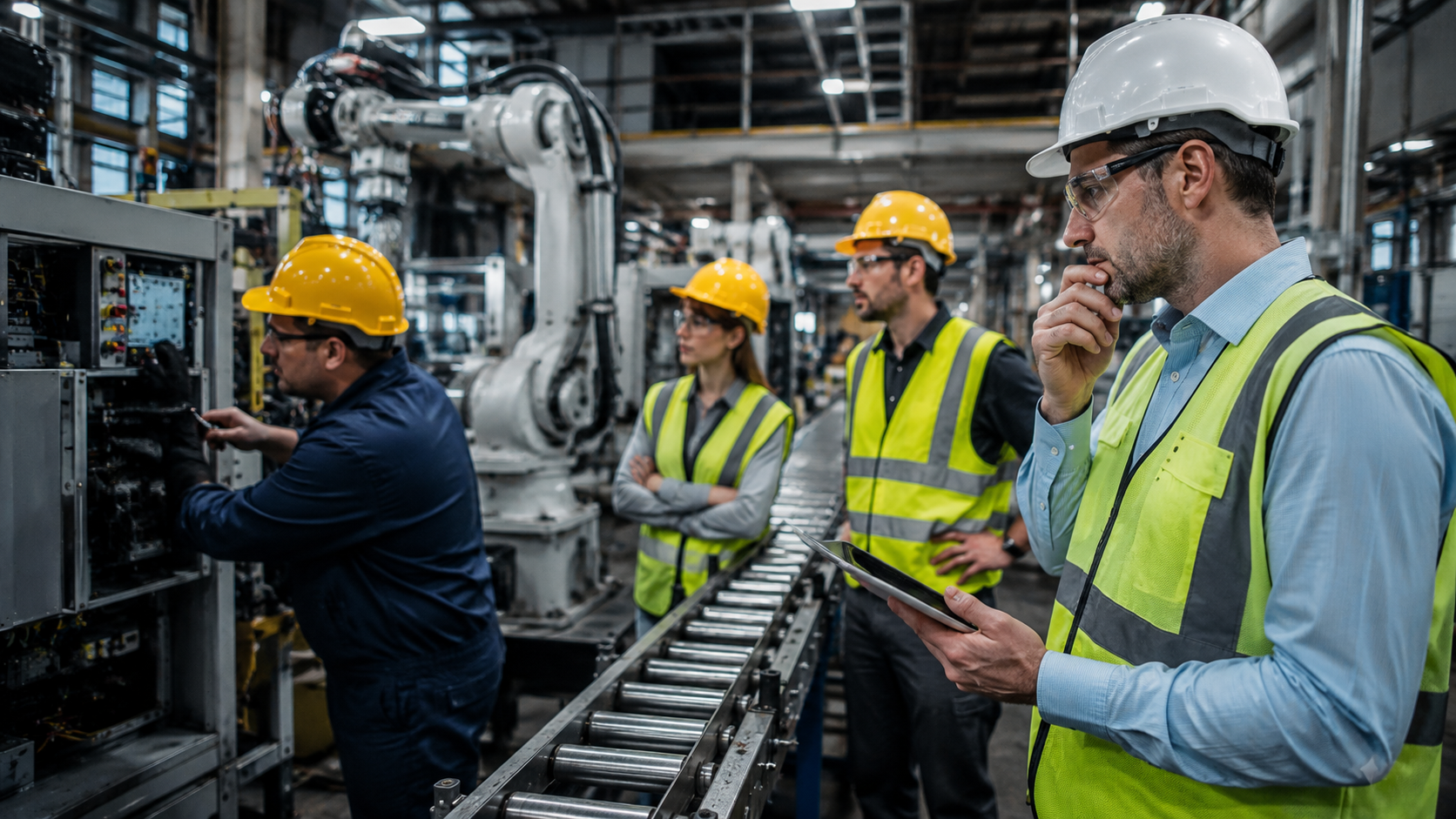
Most production lines don’t suddenly become inefficient. It usually starts with small, everyday problems: a machine that needs constant attention, materials that don’t arrive on time, or operators fixing the same issue every shift. These interruptions may only take a few minutes, but over time they add up, slowing production, increasing costs, and making it harder to keep operations running smoothly. For many manufacturers, these ongoing challenges are the first signs that it’s time to consider Industrial Automation Services as a practical solution for improving efficiency and reducing operational bottlenecks.
This is often the point where manufacturers begin thinking about industrial automation. Not because they want to replace people or build a fully automated factory, but because the current way of working is no longer sustainable. When downtime becomes routine, overtime keeps increasing, and production targets become harder to achieve, it’s worth asking a simple question: Is it time to invest in industrial automation?
- Repeated delays often point to deeper process problems.
- Automation works best when solving real production issues.
- Rising labor pressure can limit growth.
- Small automation upgrades often create big improvements.
7 Signs Your Business Is Ready to Automate
Automation is not about replacing people.
Most factories use automation to make production smoother, faster, and more consistent.
Usually, the best automation projects solve one clear problem first.
Sign 1: You’re Hitting Production Bottlenecks
Every factory gets busy sometimes.
That’s normal.
But constant production bottlenecks are different.
Maybe one machine always slows everything down. Maybe workers spend too much time moving products manually. Maybe packaging cannot keep up.
At first, teams work around the problem.
People move faster. Supervisors adjust schedules. Overtime increases.
But eventually, the process becomes stressful every day.
That’s a warning sign.
You may notice:
- Orders stacking up
- Workers waiting for materials
- Constant overtime
- Delayed shipments
- Uneven production between shifts
Many factories think they need faster machines.
Sometimes they simply need better process flow.
Sign 2: Labor Costs Are Eating Your Margins
Hiring more workers can help for a while.
But labor costs keep growing.
Training takes time. Overtime increases. Turnover creates more pressure.
This is why many companies are starting to explore labor cost automation.
The problem is not the workers.
The problem is relying too heavily on manual processes for repetitive production work.
Here’s a simple way to think about it:
If every increase in production requires hiring more people, the system may be reaching its limit.
That does not mean replacing entire departments.
Often, small automation systems help reduce pressure quickly.
Sign 3: Repetitive Manual Tasks Slow You Down
Repetitive work creates hidden problems.
Workers get tired. Small mistakes happen more often. Production slows down over time.
That’s why many factories choose to automate Material handling repetitive tasks first.
Common examples include:
- Sorting products
- Labeling
- Material handling
- Repetitive assembly work
- Manual inspections
These tasks may seem small.
But repeating them thousands of times every day affects speed and consistency.
A Simple Three-Part Evaluation
Before automating any process, many facilities evaluate tasks using three questions:
- Is the task highly repetitive?
- Does it directly limit throughput?
- Does inconsistency create downstream problems?
If the answer is yes to all three, automation may deliver fast operational impact.
Sign 4: Quality Issues Keep Recurring
One mistake is normal.
The same mistake happening again and again is different.
Manual production systems depend heavily on people staying consistent all day long. That becomes difficult during busy shifts.
This is where automation quality control becomes useful.
Automation helps reduce variation.
You may notice this problem when:
- Defects keep increasing
- Rework becomes common
- Inspection results vary
- Customers report repeat issues
- Product quality changes between shifts
Quality problems usually create other problems too.
More waste. More delays. More frustration.
Mid-Process Warning Signs Table
| Operational Signal | What It Often Means | Automation Opportunity | Common Mistake |
| Frequent manual rework | Inconsistent execution | Automated inspection or dispensing | Automating before fixing the process flow |
| Over time, every week | Capacity imbalance | Transfer or packaging automation | Hiring continuously instead |
| High operator fatigue | Repetitive motion overload | Material handling systems | Ignoring ergonomics |
| Variable product output | Process inconsistency | Integrated controls and monitoring | Blaming individual workers |
| Recurring downtime | Reactive maintenance culture | Smart monitoring systems | Replacing equipment too early |
Sign 5: You Can’t Scale Without More People
Growth sounds exciting.
Until production struggles to keep up.
Many factories hit a point where output only increases if they hire more workers.
That becomes difficult to sustain.
The idea of scaling without hiring matters because labour shortages continue to affect manufacturing.
You may already feel this pressure if:
- Overtime keeps growing
- Hiring never stops
- Training takes too long
- Supervisors spend more time managing people than production
Automation helps stabilize operations before growth becomes chaotic.
And importantly, automation does not always mean huge robotic systems.
Sometimes, smaller upgrades solve major problems.
Sign 6: Downtime Is Costing You Money
Downtime affects everything.
Production slows. Orders fall behind. Workers wait around. Stress increases across the facility.
Even small stoppages add up.
This is why many manufacturers use systems that help automation reduce downtime.
Modern systems can help by:
- Tracking machine performance
- Sending alerts faster
- Improving maintenance response
- Showing production issues in real time
Visibility matters.
When teams see problems earlier, they usually solve them faster.
A short delay repeated many times each day can quietly remove hours of production every month.
That’s often when leaders begin seriously asking:
Is my business ready to automate?
Sign 7: Competitors Are Already Automating
This does not mean you should copy everyone else.
Some businesses rush into automation too quickly.
Still, ignoring industry changes can become risky.
Today, competitive automation affects:
- Delivery speed
- Product consistency
- Production costs
- Labor dependency
- Customer expectations
And automation is no longer limited to massive factories.
Many mid-sized manufacturers now use smaller targeted systems. These systems create faster returns and less disruption.
When You May NOT Be Ready to Automate
Some businesses are simply not ready for automation yet.
That may happen when:
- Processes constantly change
- Workflows are unclear
- Production problems are not fully understood
- Leadership expects instant results
Automation improves systems.
It does not fix broken processes automatically.
One of the biggest mistakes companies make is automating inefficient workflows too early.
Simple process improvements should usually come first.
How to Take the First Step
The first step to automation is understanding where production problems begin.
Start simple.
Focus on:
- The biggest slowdown
- Repetitive manual work
- Frequent downtime
- Quality problems
- Labor-heavy tasks
Most successful automation projects start small.
One process. One bottleneck. One improvement area.
For manufacturers exploring custom automation systems, RBR Automation focuses on identifying operational problems first before building solutions. That helps avoid unnecessary complexity.
- Identify the biggest operational constraint
- Measure where labor dependency is highest
- Track recurring downtime patterns
- Analyze quality variation sources
- Prioritize one high-impact improvement area
What Most Companies Misjudge
Many people think automation is mainly about replacing labor.
Usually, it’s about creating stability.
Improve production flow, maintain more consistent quality, reduce downtime, and lower daily stress.
Those improvements grow over time.
The companies that succeed with automation often move carefully. They focus on practical improvements instead of chasing trends.
Conclusion
Factories rarely wake up “ready for automation.” The pressure builds quietly bottlenecks harden, labor gets stretched, downtime becomes routine, quality drifts. What once felt like flexibility starts feeling like a ceiling.
The signal isn’t a single crisis. It’s the pattern: manual systems that used to absorb variation now amplify it.
Automation isn’t the answer to every problem. But when the same few constraints keep limiting output, consistency, and growth despite process tweaks and overtime that’s not a people problem. It’s a system limit.
The companies that gain traction don’t chase trends. They pick one high-impact constraint, automate that specific loop, measure the change, then repeat. Stability compounds.
Frequently Asked Questions
What makes a good automation strategy?
A good automation strategy solves clear production problems first. It focuses especially on repetitive tasks and workflow delays.
How to know if production bottlenecks require automation?
If delays continue even after adding labor or overtime, automation may help improve production flow.
When to hire an automation integration company?
Many manufacturers seek help when internal teams understand the production issue. They need technical support for implementation.
What custom automation services are most common?
Material handling, inspection systems, transfer systems, and production-line automation are common starting points.
Does RBR Automation work with existing factory systems?
Yes. RBR Automation works with existing production environments. The company integrates automation systems into current operations where possible.